In this essay, I intend to discuss the findings of my questionnaire on Scottish Accents. I designed the survey to examine people’s attitudes towards the different varieties of accents commonly spoken by Scots. For the purposes of the survey, I separated these accents into three categories:
- Scots dialect (which I defined as being a broad variety of Scots that included a noticeable level of “unfamiliar words”);
- Scottish Standard English as spoken with a strong (probably regional) accent (described in the survey as a “strong accent”);
- SSE itself (described in the questionnaire as “a mild, ‘standard’ accent”).
I had several aims in designing this questionnaire. Broadly, I wanted to explore modern attitudes towards strong accents of Scots, but there were certain areas in particular that interested me. Firstly, I wanted to examine classic ideas of “social class” in this context. Secondly, I wanted to establish whether the attitudes of 16-35 year olds towards older generations of Scots speakers were any different to those of younger speakers.
The questionnaire was coded as a poll on the internet, and made available to acquaintances. This is why the respondents all have nicknames in the data of the Appendix – I found them to be a useful tool for reference, so I retained them. Twenty nine friends and acquaintances completed it, which allowed me to see a number of trends throughout the survey. Of those respondents, many are or have been Edinburgh residents, although they cover a range of nationalities, including ten Scots (34%), eleven English (38%), and four Irish (Republic). They range in age from seventeen to thirty five, sixteen female (55%) and thirteen male, and they are for the most part university educated. They are all native English speakers with fairly standard accents. Taking the latter two of these factors into account, what I will be examining is a predominantly “young middle-class” attitude towards dialect.
Twenty two (76%) of the respondents are currently based in Central Scotland, and accordingly have contact with Scottish accents on a day to day basis. The rest have less frequent contact. In broaching the subject of accents, I needed to establish to what extent the respondents could hear them. One of the first questions on Scots was:
- Q11. Tick the relevant box(es) if you can distinguish (in Scottish accents) between:
- a very broad accent (including unfamiliar, "dialect" words) & a mild, "standard" accent (ie: what you would expect to hear from a Scottish news-reader);
- a mild, "standard" accent (ie: what you would expect to hear from a Scottish news-reader) & a strong accent (but with no unfamiliar words);
- a strong accent (but with no unfamiliar words) & a very broad accent (including unfamiliar, "dialect" words).

Among those who missed one or both of the second two distinctions, there was only one Scot. In later questions, several non-Scots (all of whom missed the final distinction) brought up the issue that they had comprehension problems with both dialect Scots and strong Scottish accents. I believe this is an important factor at work here. If the respondents have issues with comprehension with both, they are significantly less likely to be able to distinguish between the two.
The question following on from #11 is open-ended, asking for initial impressions people in each of the three accent groups, across three age ranges: the under-twenties, over twenties, and over-fifties. I gathered a number if interesting responses. In the first two age groups, the responses for “broad Scots dialect”, and indeed “strong Scottish accent”, both seemed to fall into three separate attitudes, towards education, social class, and region respectively.
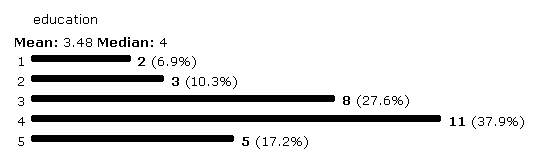
Four respondents (14%) were of the opinion that a broad or strong accent suggested a lower level of education. Of those, only one was Scottish – and her indication was that she would expect them to be from a state rather than private school, perhaps making her opinion more related to social class than education level. Later in the questionnaire (#14), I asked for people to rate (on a scale of one to five) how much they felt an accent told them about a person’s education:
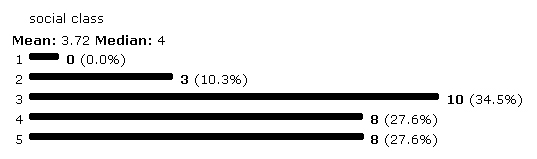
Eight respondents (26%) felt that accent was strongly indicative of social class. There was a tendency to assume both that a strong accent was working-class, and that SSE speakers were automatically middle-to-upper-class. The later “rating” question shows that whole most people (all bar three) are of the opinion that social class is to some extent important, there is a division of opinion as to just how important:
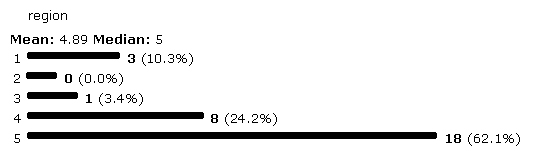
Eleven (38%) of those who took the survey held the belief that accent was more an indication of region. For the most part, respondents felt that a very broad accent was generally an indication that the person came from the more rural areas of Scotland, and that those with a strong accent were more likely to be from the central belt, but either from smaller towns, or the inner-cities. As I’ll mention later, There was also a feeling that SSE speakers were likely to come from the suburbia of cities, or from the more cosmopolitan areas of the country. This strong tendency to place people regionally speaking according to their accent was overwhelmingly borne out by the later “rating” question:
Accordingly, there seems to be a generally held belief that SSE is indicative of private or further education, and a higher social class. Nine (31%) of the respondents commented either that they associated the accent with private schooling or attendance at a university; or with middle-class Scots living in the suburban/”posh” urban areas of the country. This is not an across-the-board opinion, however. Nine other respondents said that the SSE accent made little-to-no impression whatsoever, in some cases because it is the same as their own. In addition, three people felt that a mild accent was indicative of the speaker modifying their speech to be more easily understood.
Finally, it is worth noting that several respondents indicated that they would associate a strong accent with a patriotic outlook – and indeed two English respondents said that they would be worried that the person in question might show animosity towards the English.
The final age group in question #12 bore some interesting results. The general feeling seemed to be that for older Scots, a broader dialect was more expected, and was not such a bench-mark for class, region or education as it was for younger speakers. Five respondents in particular felt that a stronger accent was expected from someone of an older generation, due to the difference in their upbringing, and the influences of modern, global culture.
Another interesting opinion was expressed about this age-band, in relation to the “mild” accent, ie: SSE. Nine (31%) of respondents made a particular point of noting that if they heard an SSE accent from a member of an older generation, they would tend to assume they were “from an upper class family, probably educated outside Scotland, or in Edinburgh” (“tisme”). “coffee_lifeform” goes so far as to state: “I'd presume they either weren't originally Scottish or came from a very wealthy family.” I conclude from this that the attitudes among 16-35 year olds towards the accents of the over-fifties are, at both extremes, are different from their attitudes towards the accents of younger speakers.
In Question #13, I attempted to establish whether there was an expectation in terms of accent in various professions. For ease of reference I used the basic government-defined social class bands from A – E, although I didn’t label them as such. The bands are as follows:
A Upper middle class - Higher managerial, administrative or professionalTo this list, I added “unemployed”, because I was interested in the potential difference in what would be expected of the unemployed as opposed to “lowest grade workers”. This resulted in some interesting figures:
B Middle class - Intermediate managerial, administrative or professional
C1 Lower middle class - Supervisory or clerical and junior managerial administrative or professional
C2 Skilled working class - Skilled manual workers
D Working class - Semi and unskilled manual workers
E Those at the lowest level of subsistence – Casual or lowest grade workers (also State pensioners, etc., with no other earner)
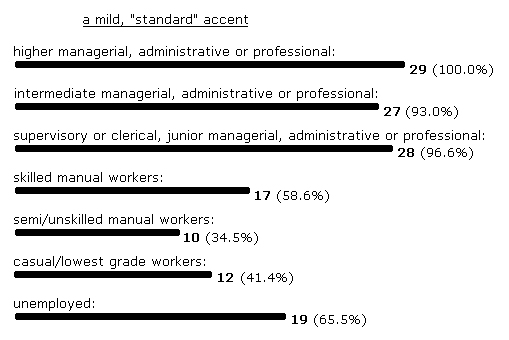
As you can see, there is a distinct jump between “casual, lowest grade workers” and “unemployed” in whether the respondents would expect to hear a mild accent. I had expected this result, as I think it reflects an acknowledgement on the part of the participants of people “between-jobs”, and also people in the period of unemployment often suffered directly post-graduation. I see this as further proof that the respondents expect those of a “lower” class to have a broader accent – the fact that they have compensated for the presence of members of a “higher” class in the unemployment bracket confirms it.
I have already discussed/presented some of the results from Question #14, the question where I asked the participants to rate a series of attributes according to whether they relate to accent. One other result of note was the overwhelming response against accent being any indication of intelligence:
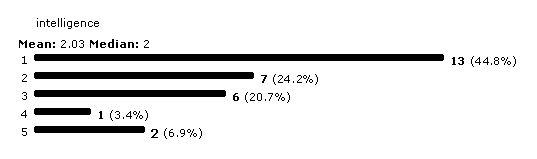
One of the things I was curious about in design the survey was whether the respondents would separate intelligence from education here. They quite decidedly have.
Finally, I asked whether there were any other factors that the respondents would take into account, were they forming an opinion on someone based upon their accent. Specifically I asked whether clothing, age, gender, or context (ie: the context in which they come into contact) would have an effect. The results here were very much as I expected. Clothing was a large factor (55% of respondents rated it either 4 or 5), possibly due to the distinctive clothing of “ned” or “chav” culture, as mentioned by some respondents in the open questions earlier. On age, they seemed unsure, 41% of them choosing the central number 3. On gender, the participants were decidedly against taking it into account; only four people (14%) rated gender as 4 or 5, with 72% sitting in the 1 or 2 camp. Finally, context seems to have been the most important factor, with 76% (22) of the respondents rating it of importance 4 or 5. The respondents were given an opportunity here to bring up any other factors they would take into account. Most often mentioned were body-language, subject-matter and demeanour.
In conclusion, I felt this survey was very successful (given its small data-set) in showing trends in attitudes towards Scots accents. I satisfied my own questions regarding social class and age groups, and even found some areas (eg: the perceived connection between strong accents and patriotism) that would be an interesting route for further study. If I were to repeat this survey, I would like to expand the age range of my respondents (I would like to survey a broader range), and similarly their social class, since most of the participants in this test were middle-class university graduates/students.